Diploma In Data Science

By Learnatic Academy
Categories: Faculty of Data Science

About Course
The Diploma in Data Science is a comprehensive and industry focused programme designed to equip learners with the knowledge, technical expertise, and analytical capabilities required to work effectively in the rapidly evolving field of data science. As organizations across industries increasingly rely on data driven decision making, the demand for skilled data professionals continues to grow worldwide. This diploma provides learners with a strong foundation in data analysis, statistical methods, machine learning, data visualization, programming, and business intelligence while developing the practical skills needed to solve real world challenges using data.
Data science has become one of the most influential disciplines in modern business, technology, healthcare, finance, education, manufacturing, government, and research sectors. Organizations generate vast amounts of information every day and require qualified professionals who can transform raw data into meaningful insights that support strategic planning, operational efficiency, innovation, and competitive advantage. This diploma prepares learners to understand data ecosystems, interpret complex datasets, and apply analytical techniques to support informed decision making in professional environments.
The programme combines academic principles with practical industry applications to ensure learners develop both theoretical understanding and hands on competence. Learners will explore data collection methods, data cleaning techniques, statistical analysis, predictive modelling, machine learning fundamentals, data visualization tools, database management, and business analytics. Through practical exercises, case studies, simulations, assignments, and project based learning activities, participants will gain valuable experience working with real world data scenarios commonly encountered in industry settings.
A strong emphasis is placed on professional skill development and workplace readiness. Learners will engage in analytical projects that strengthen critical thinking, problem solving, decision making, and technical communication skills. They will learn how to identify business problems, evaluate data quality, design analytical solutions, present findings effectively, and contribute to data driven organizational strategies. These experiences help learners build confidence while developing a professional portfolio that demonstrates their capabilities to employers and clients.
The diploma follows an industry focused and career oriented learning approach that aligns with current market demands and emerging technological trends. Learners are encouraged to participate in practical projects and professional development activities that simulate workplace expectations and industry workflows. Internship opportunities may also be available to support experiential learning and help learners gain valuable exposure to professional environments, industry practices, and organizational operations.
Graduates of this programme may pursue employment opportunities in data analysis, business intelligence, reporting, analytics support, research assistance, data management, and related fields. The qualification can also support career advancement for existing professionals, create opportunities for freelance consulting services, assist entrepreneurs in making data driven business decisions, and provide a pathway toward further academic study in data science, artificial intelligence, analytics, information technology, or related disciplines.
Learnatic Academy provides career guidance and professional development support throughout the learning journey. Through its Hiring and Placement Network, the academy assists qualified graduates by connecting them with relevant employment opportunities whenever available. This support helps learners strengthen their employability, professional confidence, and readiness for the global workforce.
Learnatic Academy is a UK and Singapore Accredited institution and an Approved CPD Provider. The academy is recognized by The CPD Group UK, International CPD Standards Board UK, and Online CPD Accreditation Singapore, ensuring that learners receive education aligned with internationally recognized quality and professional development standards.
Course Content
Module 1: Foundations of Data Science and Statistical Thinking
-
Lecture 1: Introduction to Data Science and Modern Analytics
03:40:30 -
Lecture 2: The Evolution of Data Science Across Industries
40:50 -
Lecture 3: Roles and Responsibilities of a Data Scientist
12:25 -
Lecture 4: Understanding Data Driven Decision Making
02:30:40 -
Lecture 5: Applications of Data Science in Business
55:02 -
Lecture 6: Applications of Data Science in Healthcare
10:12 -
Lecture 7: Applications of Data Science in Finance
02:30:18 -
Lecture 8: Applications of Data Science in Retail and E Commerce
02:30:40 -
Lecture 9: Data Science Lifecycle Overview
02:57:30 -
Lecture 10: Types of Data and Data Sources
04:07:12 -
Lecture 11: Structured, Semi Structured, and Unstructured Data
02:38:22 -
Lecture 12: Introduction to Data Analytics Frameworks
03:05:12 -
Lecture 13: Key Concepts in Statistics for Data Science
03:50:20 -
Lecture 14: Understanding Data Quality and Reliability
03:45:59 -
Lecture 15: Introduction to Data Science Tools and Technologies
10:07 -
Lecture 16: Data Science Career Pathways
17:15 -
Lecture 17: Ethical Responsibilities of Data Professionals
05:57 -
Lecture 18: Introduction to Data Science Projects
15:52 -
Lecture 19: Mathematical Thinking for Data Analysis
12:59 -
Lecture 20: Review of Algebra for Data Science
32:12 -
Lecture 21: Functions and Graph Interpretation
22:59 -
Lecture 22: Linear Equations and Systems
15:35 -
Lecture 23: Matrices and Matrix Operations
07:02 -
Lecture 24: Vectors and Vector Spaces
45:20 -
Lecture 25: Introduction to Linear Algebra Applications
15:32 -
Lecture 26: Probability Fundamentals
22:58 -
Project: Industry Data Insights Dashboard Development Project
Module 2: Statistical Analysis and Python Programming Fundamentals
Module 3: Advanced Python Development and Data Acquisition
Module 4: Database Systems and Data Preparation
Module 5: Data Cleaning, Analysis, and Visualization
Module 6: Exploratory Analytics and Business Intelligence
Module 7: Applied Analytics and Machine Learning Foundations
Module 8: Supervised and Unsupervised Machine Learning
Module 9: Advanced Machine Learning and Deep Learning
Module 10: Natural Language Processing and Big Data Technologies
Module 11: Big Data Engineering, Cloud Computing, and MLOps
Module 12: Data Science Governance, Ethics, and Professional Practice
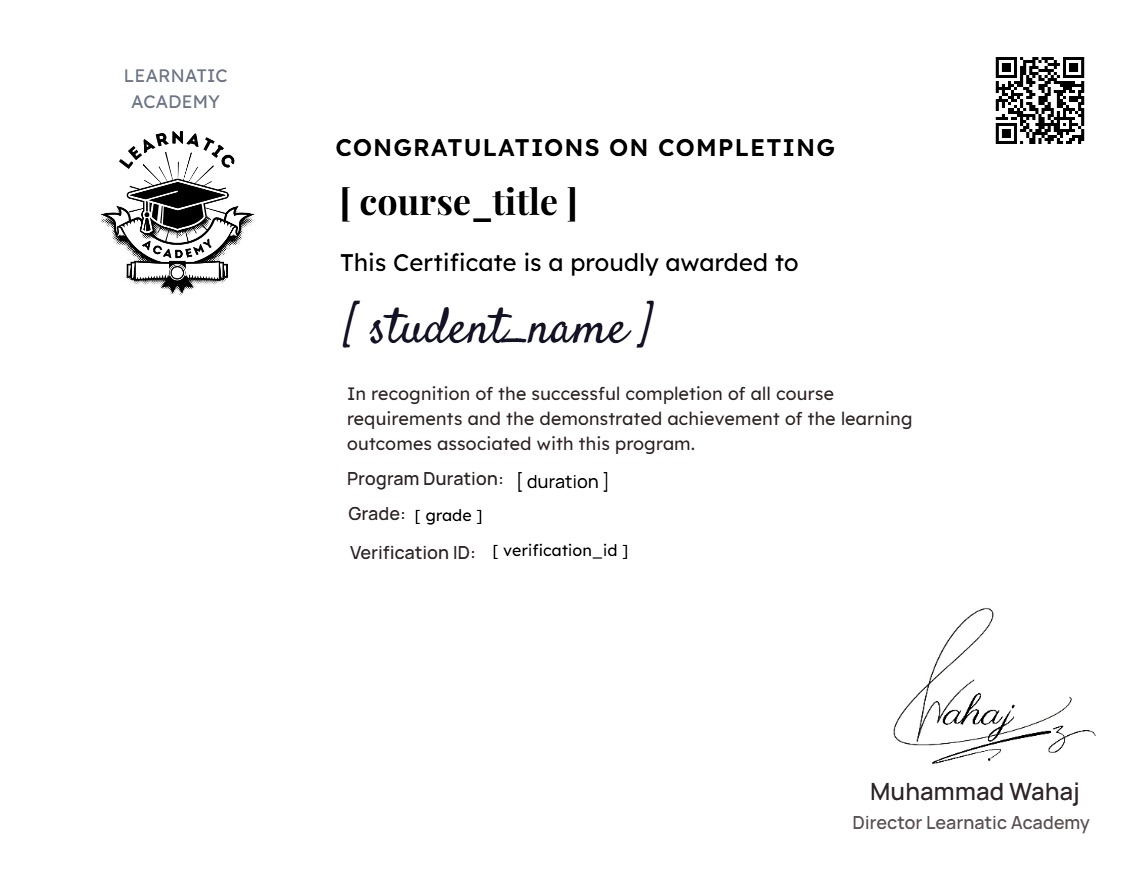
Earned Certificate
Certificates Awarded To Students For Successfully Completing Courses At Learnatic Academy
Student Ratings & Reviews

No Review Yet

Want to receive push notifications for all major on-site activities?
✕